AI Overview
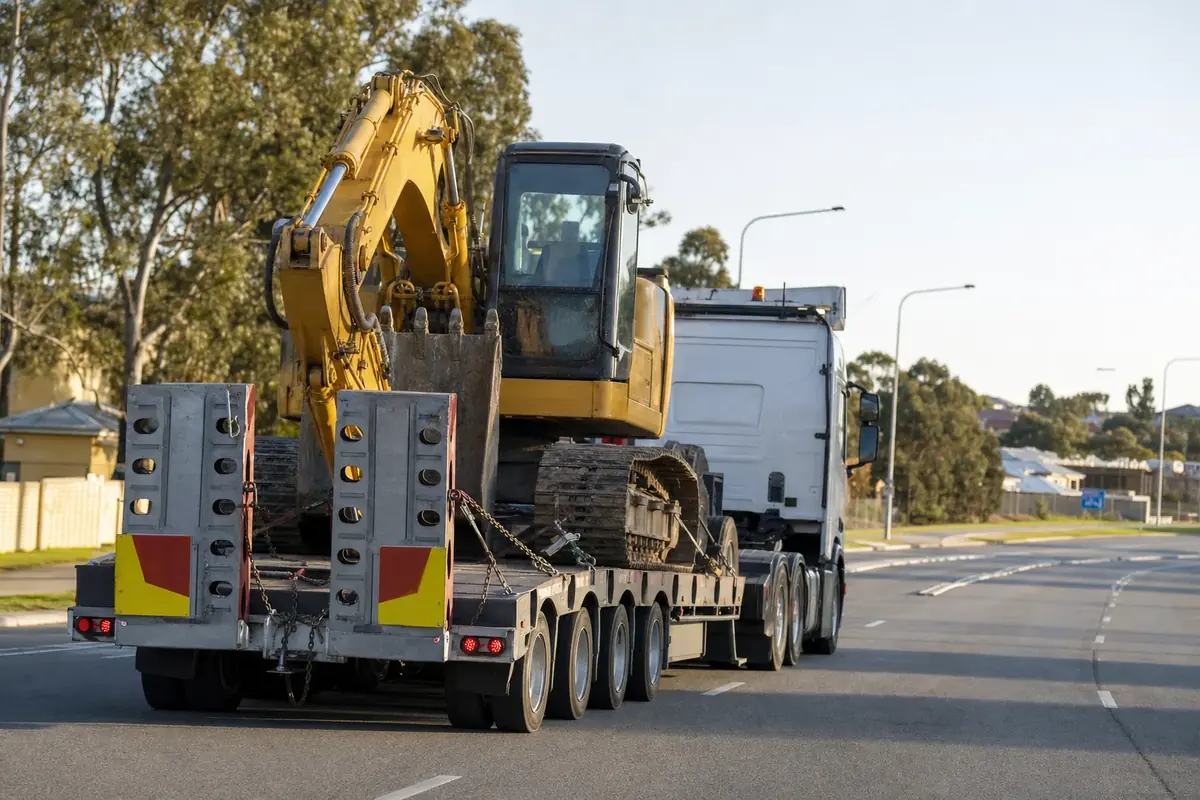
Transport is the single biggest cost variable in Perth plant hire - mobilising a 13.8t excavator to a site 60km away can add as much to the day rate as the difference between machine sizes. Wet hire (machine plus operator) runs from around $1,200-2,000/day for excavators depending on size, while dry hire starts from around $400-500/day for smaller machines. Site access affects how long the job takes more than people expect - a tight side gate or a narrow driveway that requires repositioning adds time to every hour billed.
Key Highlights
- Transport is often the biggest single cost, not the machine day rate
- A 13.8t excavator 60km from the yard costs more to mobilise than a 1.8t mini locally
- Wet hire runs from around $1,200-2,000/day for excavators, dry hire from $400-500/day
- Site access problems add time to every hour of the job
- Machine size selection matters - an undersized machine takes longer and costs more overall
- A firm all-in quote beats an hourly rate for most residential jobs
Summarise This Article With AI
Open this article in your AI assistant for a plain-language summary and a straight answer on the machine your job needs.
Why Transport Is the Biggest Variable
Most people focus on the machine day rate when comparing plant hire quotes. The number that actually moves the final invoice around most is transport - specifically, how far the machine has to travel from the hire company's yard to your site and back.
A large excavator travelling 60km each way is a meaningful cost. At typical Perth transport rates, that round trip adds significantly to what you pay for the day, regardless of what the machine itself costs to hire. A company quoting you a low machine rate but charging separately for transport at the end can end up more expensive than a firm all-in quote from the outset.
How Transport Scales by Machine Size
Larger machines take more to move, cost more to run and take longer to load and unload. A 1.8t mini excavator behind a ute is a very different transport cost from a 13.8t excavator. Machine weight also affects what roads can be used.
| Distance to Site | PC18 Mini | PC55 Mid | PC138 Large |
|---|---|---|---|
| Under 20km | Transport is a small fraction of the day cost | Similar - shorter haul | Still significant at large machine scale |
| 20-40km (most Perth metro) | Moderate transport component | Transport becomes meaningful | Transport is a major day cost driver |
| 40-60km (outer suburbs) | Transport is noticeable in the quote | Transport is a large component | Transport may exceed machine rate |
| 60-80km (Mandurah etc.) | Transport is the dominant cost variable | Transport dominates | Significant - factor into the budget |
Always Ask for an All-In Quote
When comparing plant hire quotes in Perth, always ask what is included in the day rate. Transport, fuel, operator (for wet hire) and GST should all be clear before you compare numbers. A quote that leaves transport for a separate bill at the end is harder to compare and often more expensive in total.
Machine Size and Daily Rates
Machine size affects both the hire rate and how quickly the job gets done. Choosing a machine that is too small costs more overall because the job takes longer. Choosing a machine that is too large wastes money on hire rate if the smaller machine could have done the job in the same time.
| Machine | Weight | Typical Job | Indicative Wet Hire Rate |
|---|---|---|---|
| Komatsu PC18 | 1.8t | Tight access, backyard pools, soakwells, side-gate jobs | From ~$1,200/day |
| Komatsu PC55 | 5.5t | Residential site cuts, trenching, retaining walls | From ~$1,500/day |
| Komatsu PC138 | 13.8t | Full site cuts, bulk earthworks, hard ground | From ~$1,800-2,000/day |
| Bobcat T450/T590 | ~4-5t | Levelling, driveways, site clean-up | From ~$900/day |
| 8t Isuzu tipper | 8t | Spoil and soil cartage | From ~$120-150/load |
When the Bigger Machine Is the Cheaper Option
A 5.5t excavator on hard Perth limestone cuts significantly faster than a 1.8t mini. If the mini takes three days on a job the 5.5t handles in one, the larger machine's higher day rate is not the more expensive choice. This is something experienced operators know and homeowners often do not find out until the job is already going slowly.
Call us with the job details and we'll recommend the machine size that finishes the job in the fewest days. That is not always the largest machine - on a tight side-access pool dig, the PC18 is often the faster choice because repositioning a larger machine in a confined space takes more time than the extra digging speed gains.
How Wet and Dry Hire Affect the Price
Dry hire day rates are lower than wet hire because the operator is not included. For a licensed contractor with their own crew already on site, dry hire can make economic sense. For everyone else, the calculation is more complex.
If you do not have a licensed operator and need to hire one separately, the cost can match or exceed the wet hire rate. If your operator is unfamiliar with the machine type and digs slower or makes mistakes, the dry hire savings disappear in extra hours. Wet hire eliminates those variables.
The Komatsu-Trained Edge on Cost
Our operators service their own machines. If a hydraulic issue or mechanical problem develops on site, it gets sorted by the operator, not by waiting for a third-party mechanic. A two-hour breakdown wait on a day rate job is a real cost. Komatsu-trained operators who fix their own gear eliminate most of that risk.
Site Access and What It Does to the Price
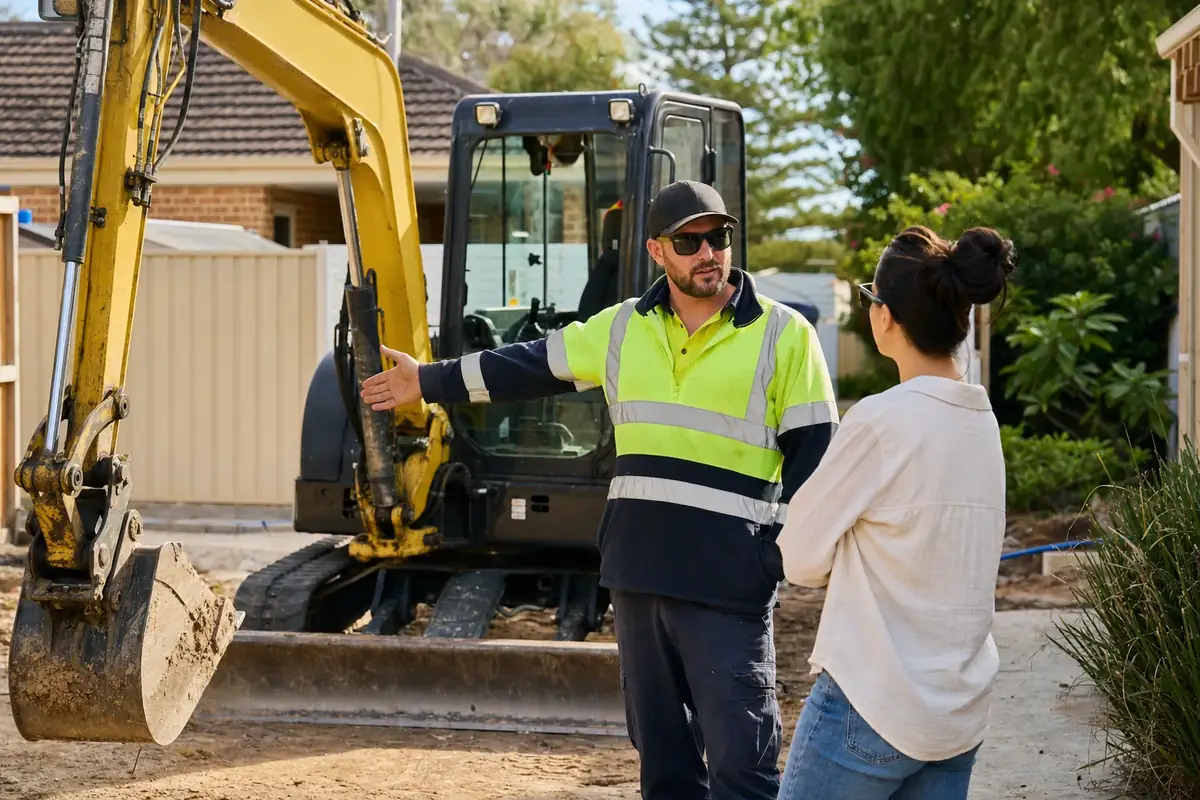
Access is the cost factor people most consistently underestimate. A standard residential lot with clear driveway access and a wide side gate loads and unloads quickly. A site with a narrow driveway, a low fence line, overhead power or underground services near the dig adds time to every part of the job.
- Narrow side gates require a smaller machine, which may take longer on the dig
- Low overhead clearance limits machine height and attachment options
- Underground services near the excavation zone require careful manual clearance first
- Soft or uneven ground near the access point slows machine positioning
- No spoil staging area means more frequent tipper runs, adding to cartage costs
How to Give Us the Right Access Information
When you call for a quote, measure your narrowest access point (gate or driveway width), note whether there are overhead lines, and tell us if there are known underground services near the dig. That information lets us confirm the right machine and give you an accurate time estimate - which is what the final price is based on.
Transport
#1 Cost Variable
Distance from yard to site drives more price variation than machine size
Machine Size
#2 Cost Variable
Right-sized machine finishes faster - cheaper overall even at a higher rate
Wet/Dry
#3 Variable
Wet hire includes the operator; dry hire lower rate but more responsibility
Access
#4 Variable
Tight access adds time to setup, positioning and spoil removal
Attachments, Rock Breakers and What They Add to the Cost
Most plant hire quotes are based on the machine with a standard bucket. When a job requires a different attachment - a hydraulic rock breaker, a narrow trenching bucket, a compaction plate or a ripper tooth - there is typically an additional cost for the attachment itself and sometimes for swapping it over on site.
Hydraulic Rock Breakers
A hydraulic hammer (rock breaker) is the attachment most commonly requested on top of the standard bucket. Perth limestone and ironstone formations are hard enough that a standard bucket makes slow progress or cannot penetrate at all. A rock breaker on the PC55 or PC138 breaks that material so the bucket can clear it. The breaker adds to the day rate and is quoted separately when the job requires it.
Narrow Trenching Buckets
Service trenches for pipes, conduits and drainage runs are often dug with a narrow bucket - typically 300mm or 450mm wide rather than the standard 600mm excavating bucket. The narrower bucket keeps the trench tight and minimises spoil volume, which reduces cartage costs. For wet hire jobs where trenching is the primary task, ask us whether a narrow bucket is already included or available.
| Attachment | Typical Use | Cost Impact |
|---|---|---|
| Standard excavating bucket | General earthmoving, site cuts, soakwells | Included in day rate |
| Hydraulic rock breaker | Limestone, ironstone, hard fill breaking | Additional daily rate applies |
| Narrow trench bucket (300-450mm) | Service trenches, conduit runs, drainage | Often included - confirm on quote |
| Compaction plate | Trench backfill compaction | Additional attachment rate |
| Ripper tooth | Surface ripping before bulk earthworks | Additional attachment rate |
Tell Us About Hard Ground Early
If you know or suspect the site has limestone, ironstone or old concrete, mention it when you call for a quote. A job quoted as standard earthmoving that turns out to be solid limestone halfway down takes significantly longer than expected, and the cost of a rock breaker is much easier to plan for than an unbudgeted cost on the day.
Spoil Cartage: The Cost That Catches People Off Guard
Spoil cartage is the cost of removing the material that comes out of the ground. It is billed separately from the excavation day rate in almost all cases, and on jobs where significant material has to be removed - a full site cut, a deep soakwell installation, a large pool excavation - it can become a substantial line item.
Why Spoil Volume Is Hard to Estimate
Material expands when it comes out of the ground. Sandy loam that measures as 50 cubic metres in the ground becomes 60-65 cubic metres of loose spoil once excavated. That expansion factor means more tipper loads than the raw excavation volume suggests. On hard material that has to be broken before it can be loaded, the volume often runs higher again.
How Tipper Cartage Is Priced in Perth
Our 8t Isuzu FVR tipper is priced from around $120-150 per load, which covers loading, cartage to a disposal or reuse site and return. The number of loads a job requires depends on the volume of material, how close the disposal site is and whether any material can be reused on site. Reusing clean sandy loam as fill in another area of the same site avoids cartage costs on that portion of the material.
~20-25%
Swell Factor
Excavated spoil occupies more volume than in-ground material - plan for more loads
~8t
Per Tipper Load
Isuzu FVR payload - approximately 4-5 cubic metres per load for sandy material
$120-150
Per Load (indicative)
Includes loading, cartage and disposal - confirm with us based on your distance
On-Site Reuse
Best Way to Save
Clean spoil reused as fill eliminates cartage costs on that volume
What Can and Cannot Be Disposed of at Standard Fill Sites
Clean sandy loam and clay without contamination can go to most standard fill disposal sites in the Perth metro area. Material with concrete rubble, asphalt, treated timber or chemical contamination requires disposal at a licensed facility, which costs more. If you have any reason to suspect the site has been previously used for industrial, commercial or orchard activity, mention it when you call - it affects where the spoil can legally go.
Contaminated Fill: A Cost and a Legal Issue
Dumping contaminated fill at a standard disposal site is an offence under WA environmental legislation. If the material contains chemical residue, asbestos fragments, petroleum products or treated timber, it must be classified and disposed of at a licensed facility. The classification and disposal costs can be significant. A brief conversation about the site history avoids a nasty surprise on the disposal end.
How to Get an Accurate Quote the First Time
Most plant hire quotes that end up inaccurate do so because the customer did not have all the information available when they called. A five-minute conversation with the right details results in a quote you can budget against with confidence. A call missing key information produces a ballpark that may not match the final invoice.
- 01
Know the Job Type and Size
Be clear on what needs to be dug, how deep and over what area. For a pool, know the internal dimensions. For a site cut, know the lot dimensions and target level. For trenching, know the length and service size.
- 02
Measure Your Access Point
Measure the narrowest gate or driveway opening at its tightest point. The PC18 needs approximately 900mm, the PC55 needs approximately 1.8m, the PC138 needs approximately 2.5m. This determines which machines are actually available for your site.
- 03
Note Any Overhead or Underground Constraints
Tell us if there are overhead power lines near the dig, underground services confirmed by Dial Before You Dig, or retaining walls or structures adjacent to the excavation zone. These affect how the job is approached.
- 04
Confirm Spoil Destination
Decide whether spoil is being removed from site, stockpiled for later use or redistributed within the property. Each option has a different cost implication. If you want removal, note your suburb - the distance to disposal affects the cartage rate.
- 05
Choose Wet or Dry
Confirm whether you need wet hire (machine and operator) or dry hire (machine only). Have your operator's licence details ready if you are enquiring about dry hire.
Practical Ways to Keep Your Plant Hire Costs Down
Plant hire in Perth does not have to be expensive if the job is planned well. The biggest savings come from reducing the cost drivers that are actually controllable - transport, machine selection, spoil volume and site preparation.
Choose the Machine Closest to Your Job
Transport is the biggest controllable variable. A hire company with a yard in the northern suburbs costs less to mobilise to a Wanneroo job than a company based in Kwinana, regardless of their machine rate. When comparing quotes, factor in where the company is based and how far the machine is travelling.
Right-Size the Machine for the Ground
The cheapest machine is not always the smallest machine. On hard limestone or deep excavations, an undersized machine takes two or three times as long to complete the job. Pay for the machine size that finishes in one day rather than the one that takes three. The day rate difference between the PC18 and PC55 is far less than the cost of two extra days on site.
Reuse Clean Spoil Where Possible
If you have clean sandy loam coming out of a dig and a fill requirement elsewhere on the same property, using the spoil as fill avoids cartage cost on that volume. A pool excavation that produces sandy spoil can often offset the cost of backfilling garden beds, levelling a rear yard or raising a low section of the block.
Prepare the Site Before the Machine Arrives
Machine hire runs from the time the machine arrives on site. A site that is clear of furniture, garden waste, fencing and rubbish before the machine gets there means the operator can start digging immediately. Every hour spent on site preparation with a machine running on day rate is an avoidable cost.
- Choose a hire company close to your job site to reduce transport costs
- Right-size the machine - a slower machine finishing in three days costs more than a larger one finishing in one
- Book on a firm day rate rather than hourly to cap your maximum cost on straightforward jobs
- Reuse clean spoil on site as fill rather than paying for cartage and disposal
- Clear the site of obstacles before the machine arrives so it can start digging immediately
- Get an all-in written quote before the job starts so there are no surprises at invoice time
The Cheapest Quote Is Not Always the Best Value
A quote that looks low often leaves out transport, uses undersized machines, or skips the operator cost. The total cost of the job - machine, operator, transport and spoil cartage - is the number to compare. An all-in quote from a Komatsu-maintained fleet with trained operators is easier to budget and often more competitive than a cheap machine rate with expensive add-ons.
Lining up a job in Perth?
We prefer calls, get straight through to the team.
The Plant Hire Perth Team
Plant Hire Perth is a Perth owned and operated plant hire and earthmoving team. Our operators are Komatsu trained and run the gear themselves, so the advice here comes from real jobs across the metro.
Published 26 June 2026 · Last updated 28 June 2026
Hire The Gear From This Article
Ready to put this into practice? Here are the hire options that suit the work above.