
Grass Tree Harvesting in Perth
Lifting 50 Australian grass trees in a single job is not a standard earthmoving task. Here is how we approached the trenching, root ball exposure and extraction on one of the more memorable jobs we have done.
Call Us Now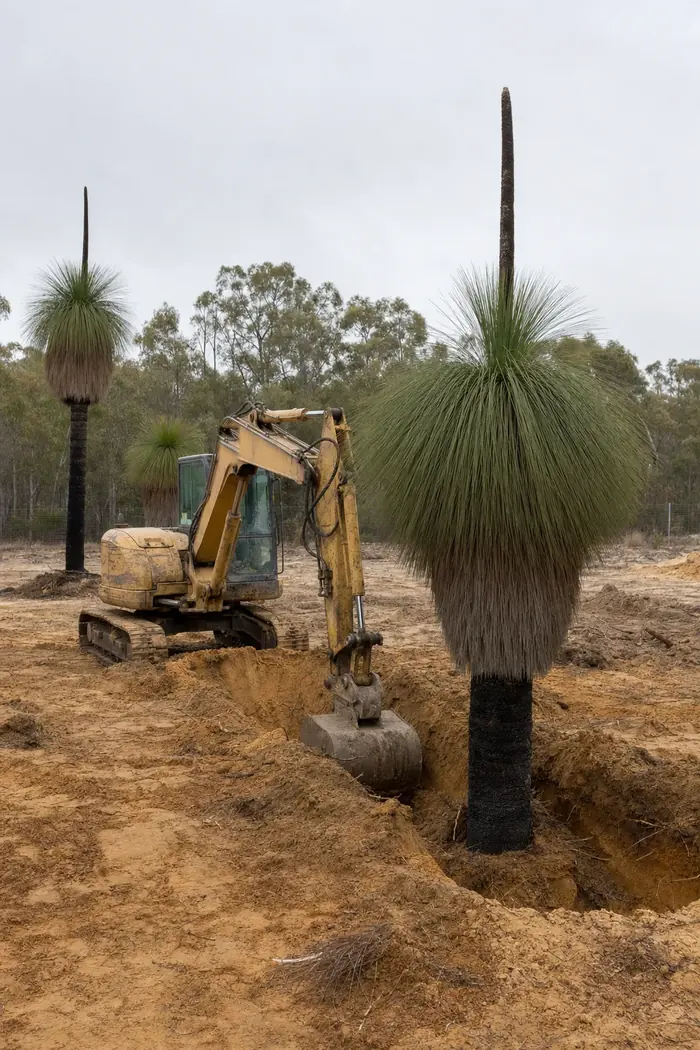
The Job File
- Where
- A development site in the Perth metro, before ground breaking
- Scope
- Roughly 50 Xanthorrhoea grass trees lifted for relocation
- Machine
- Komatsu PC55, 5.5 tonne, worked in the lower part of its range
- The Trench
- 400 to 600mm clear of the trunk, down 600 to 800mm, out to 900mm on the big ones
- Weight
- Around half a tonne per root ball, the larger specimens closer to 600 to 700kg
- Outcome
- All out with the root balls intact and ready for transplanting
Lifting 50 Xanthorrhoea grass trees (also known as grass trees or black boys) required trenching carefully around each root ball, exposing the fibrous root system without damage, and using the Komatsu PC55 5.5t to lift root balls weighing close to half a tonne each. The job took precise machine control rather than brute force, since the trees needed to survive transplanting. This type of specialist grass tree harvesting is increasingly common on Perth development and revegetation projects.
Fifty Grass Trees Off A Block Before Ground Breaking
A client needed to relocate approximately 50 Australian grass trees (Xanthorrhoea australis, commonly called grass trees or black boys) from a development site before ground-breaking. The trees ranged from smaller specimens of around 1m to larger established plants with trunks over 1.5m tall and root systems that had been in the ground for decades.
Grass trees grow extremely slowly - a trunk height of one metre can represent 50 to 100 years of growth. Losing a tree due to poor extraction technique is not a small thing. The client had the appropriate approvals in place and needed the trees extracted in a way that gave them the best possible chance of survival at their new location.
This was not a standard earthmoving job. It required careful machine control, a good eye for root depth, and an operator who could adjust technique from tree to tree rather than applying the same approach to all 50.
Why Grass Trees Are Technically Demanding to Move
Xanthorrhoea root systems are fibrous and spread wide rather than deep. The root ball holds together reasonably well if approached correctly, but a rushed or poorly directed bucket cuts through roots that the tree needs to recover. The trench has to go in clean, the lift has to be controlled, and the bucket angle matters. You cannot rush this.
A Grass Tree In Section
The same section applies to all fifty. What changes is how far out the trench sits and how deep it goes.
- 01
The Tree. Trunk, skirt and flower spike. A metre of trunk can be fifty to a hundred years of growth, which is the whole reason the job is done slowly.
- 02
The Clearance. The trench runs 400 to 600mm clear of the trunk, sized off the tree, so the cut never reaches the roots it has to live on.
- 03
The Depth. 600 to 800mm on the smaller trees and out to 900mm on the big ones, cut at low crowd force so the outer roots sever cleanly instead of tearing.
- 04
The Root Ball. Fibrous, and spread wide rather than deep. Close to half a tonne on a mature specimen, and it has to come up in one piece.
- 05
The Anchoring Roots. Freed last, with the bucket worked in under the ball. Pulling before this point is what snaps a trunk at the base and kills the tree.
How We Approached The Extraction
Not all 50 trees were the same size or in the same ground conditions. Before starting the first trench, the crew walked the site and identified which trees had deep-set trunks, which were sitting in harder ground and which had neighbouring roots or obstacles that would complicate the lift. From there the method is the same six steps, repeated fifty times.
Six Steps Per Tree, Fifty Times Over
The first few set the trench depth for that ground. From there it is repetition.
Walk The Site
Trunk height, root spread and ground condition, tree by tree. The big ones and the ones sitting in hard going get a different trench to the rest.
Trench The Perimeter
The ring goes in 400 to 600mm off the trunk at low crowd force. The aim is to sever the outer roots cleanly, not to drag the wall of the trench into them.
Trench To Depth
600 to 800mm on most of them, 900mm on the larger specimens. Rushing this step and pulling early is the main way a grass tree is lost in extraction.
Free The Base
With the ring cut and the outer roots clear, the base is separated from the subsoil underneath before anything is asked to lift.
Controlled Lift
Slow and even, with no twist in it. A jerky pull here turns the root ball and snaps the trunk at the base, and the tree does not come back from that.
Load And Move
Onto the transport or a holding row, set down rather than dropped. Fifty of them came off that site this way, root balls whole and ready to go back in.
What Fifty Root Balls Actually Weigh
When you multiply half a tonne per tree by 50 trees, you are looking at roughly 25 tonnes of root balls moved across a single job. That is a significant excavation task even before you account for the precision required on each individual extraction.
50
Grass Trees Extracted
All Xanthorrhoea australis on a single Perth site
~0.5t
Per Root Ball
Larger specimens closer to 600-700kg
PC55
Machine Used
Komatsu PC55 5.5t - right combination of reach and control
6
Steps Per Tree
Assess, trench perimeter, trench depth, free base, lift, load
Why the PC55 Was the Right Machine
The PC138 13.8t would have been too large and would have made the fine control required on each extraction harder to achieve. The PC18 1.8t mini lacked the reach and lifting capacity for the bigger root balls. The PC55 5.5t sits in the middle - enough power to lift a heavy root ball cleanly, precise enough to work close to a trunk without damaging it.
Being Komatsu-trained matters on a job like this. The PC55's hydraulic controls were operated at partial throttle for most extractions - high RPM and fast bucket movement is exactly wrong for grass tree lifting. Knowing the machine's control range and working in the lower part of it is an operator skill, not a machine spec.
What This Job Taught Us About Specialist Earthmoving
Most plant hire jobs are about moving dirt efficiently. Grass tree harvesting is about moving living organisms with a root system that has been in the ground for potentially a century. The patience required is different from a standard dig.
A Standout Job Done Right
Fifty grass trees, all extracted cleanly, root balls intact and ready for transplanting. This is the kind of job that shows what a Komatsu-trained crew operating the right machine can actually do when care is applied. Not every earthmoving job is about cubic metres per hour.
- Machine selection matters - mid-size gave control without sacrificing capacity
- Operator experience with the full throttle range of the machine is critical
- Adapting technique tree by tree is faster than applying one method to all
- The trench depth step is where most extractions succeed or fail
- Working with living plant material requires patience standard earthmoving does not
Why Grass Trees Are Worth Preserving On Perth Development Sites
Xanthorrhoea australis is a long-lived, slow-growing native plant that takes decades to reach the sizes commonly seen on Perth development lots. A specimen with a 1m trunk has been growing since before most of the suburb around it existed. That is irreplaceable habitat value and significant ecological age packed into a single plant.
From a practical development standpoint, mature grass trees attract premium prices in the nursery and landscape market. Developers who preserve and relocate them rather than clearing them outright can often recoup meaningful value from the transplanted stock. The economics of careful extraction, when done correctly, often stack up clearly against losing the trees altogether.
Ecological and Landscape Value
Grass trees flower prolifically after fire or disturbance, producing long flower spikes that attract honeyeaters and other native fauna. In revegetation and native garden settings, a transplanted mature specimen creates instant visual impact that a tube-stock plant will not achieve for 20 to 30 years. That alone justifies the care taken in extraction.
Grass Trees Are a Protected Native Species in WA
Moving, selling or disturbing Xanthorrhoea without the required permits is an offence under WA legislation. The Department of Biodiversity, Conservation and Attractions (DBCA) manages translocation licences for native plants. Confirm your permits are in order before any harvesting work begins.
- Mature specimens can represent 50 to 100 years of undisturbed growth
- Transplanted grass trees are in demand for revegetation and high-end landscaping
- Flower spikes attract native birds and insects - significant biodiversity value
- A living specimen moved correctly outperforms tube stock planted for years in one site visit
- DBCA translocation permits are required before any extraction begins
What Decides Whether A Transplanted Grass Tree Survives
Grass tree survival after transplanting comes down to four factors: root ball integrity at extraction, how long the plant spends out of the ground, the quality of planting at the new site, and aftercare in the first wet season. The extraction itself is only the first variable, but it is the one that determines what all the others have to work with.
Root Ball Integrity
A root ball that was trenched cleanly and lifted evenly arrives at the new site with its fibrous root mass largely intact. A root ball that was torn, dropped or twisted loses much of that mass, and the tree has to regenerate root structure from a stressed starting point. Clean extraction is not just an aesthetic goal - it is the survival mechanism.
Time Out of the Ground
Grass trees are relatively resilient compared to many natives, but extended time out of the ground stresses any plant. On the 50-tree job, trees were moved directly from extraction to transport and replanted the same day where possible. Where staging was required, root balls were kept in shade and watered to prevent desiccation.
Planting Depth and Aftercare
Grass trees should be planted at the same depth they grew at the source site. Burying the trunk crown invites crown rot. Planting too shallow leaves the root ball exposed. Deep watering in the first two wet seasons and mulching around the base (not touching the trunk) gives the best chance of establishment.
| Factor | Impact on Survival | Who Controls It |
|---|---|---|
| Root ball integrity at extraction | Very high | Excavator operator |
| Time between extraction and replanting | High | Site logistics and planning |
| Planting depth at new site | High | Landscaper or client |
| First-year watering regime | Moderate to high | Client |
| Mulching and crown protection | Moderate | Client |
| Ground disturbance around new planting | Moderate | Client |
The Trenching Step Is Where Extractions Succeed Or Fail
Of the six steps in a grass tree extraction, the trench is where most jobs are decided. A correctly placed trench at the right depth severs the outer roots cleanly, leaves the root ball coherent and makes the lift straightforward. A trench that goes too close to the trunk, cuts at the wrong angle or stops short of the anchoring root depth creates problems that cannot be fixed at the lift stage.
Where The Trench Goes, 400 To 600mm Off The Trunk
For most Xanthorrhoea specimens in Perth, the trench perimeter sits 400-600mm out from the trunk. Smaller trees go closer to 400mm; larger, older specimens with wider root spread may require 600-700mm to avoid cutting through the main structural roots. Going too tight saves a little time but risks cutting the roots the tree needs most.
Trench Depth and Perth Soil Types
Sandy Perth soils allow roots to run deeper than compacted clay or limestone-rich ground. On sandy sites we typically trench to 700-900mm to find and free the anchoring roots. On harder ground, 600-700mm is often sufficient because root penetration is shallower. Reading the soil type before you start is part of the site assessment.
The Most Common Extraction Mistake
Pulling too early is the single most common extraction mistake. Operators who have not done grass tree work before often assume the tree is ready to lift when the trench looks complete. If the base has not been worked free from the subsoil, pulling creates a lever that twists the trunk at the crown. That is fatal to the plant in most cases. Take the extra five minutes to free the base properly.
What Low Crowd Force Means In Practice
Crowd force is the inward curl pressure of the excavator bucket. On a standard earthmoving job you use full crowd to rip through material quickly. On a grass tree trench, high crowd force compresses the trench wall into the root system rather than slicing cleanly past it. Running the PC55 at reduced crowd force - around 30-40% of maximum - gives clean cuts and does not pack the root ball.
Site Care And What Happens After The Lift
The extraction site itself requires attention after the trees come out. Each grass tree leaves a 400-900mm deep void in the ground surface. On a development site heading to earthworks, those voids are backfilled and compacted in the normal course of grading. On a revegetation site, they are filled with topsoil and native seed mix.
Spoil Management on Grass Tree Sites
The material extracted during trenching is typically sandy loam or sandy clay, depending on where in Perth the site sits. On our 50-tree job, the spoil was stockpiled on site for reuse in backfilling the voids after the client's ground-breaking work was complete. In cases where the spoil is not wanted, our 8t tipper handles cartage.
Can a Single Machine Do Both the Extraction and the Site Work?
On most jobs, yes. The PC55 we used for the grass tree harvesting on this job is the same machine that would handle subsequent site cuts, pad preparation or drainage trenching on the same lot. Mobilising a machine for both tasks on the same site is worth discussing when you call - it often makes more sense to schedule the extraction and the follow-on earthworks on consecutive days with the same machine on site.
- Each extraction leaves a void that needs backfilling or seeding depending on what comes next
- Trenching spoil can be stockpiled on site for reuse rather than carted away
- The PC55 that does the extraction can handle subsequent earthworks on the same job
- Combining grass tree extraction with follow-on site work reduces total mobilisation costs
- Call us to discuss sequencing both tasks in a single site visit
Questions About Jobs Like This
Yes. We have completed grass tree harvesting jobs using the Komatsu PC55. The job requires careful trenching around each root ball and a controlled lift - it is specialist work that goes beyond standard earthmoving. Call us to discuss your specific job.
We use the Komatsu PC55 5.5t for most grass tree harvesting. It has enough lift capacity for heavy root balls (up to around 700kg) and the hydraulic control to work precisely around the trunk without damage. The PC18 is too small for larger specimens; the PC138 is too large for the fine work required.
A mature Xanthorrhoea root ball typically weighs between 400kg and 700kg depending on the size of the specimen and how well-established the root system is. Larger grass trees with trunks over 1.5m can run heavier.
They can, provided the extraction technique is correct. The trench must go clean around the root system without tearing major roots, the base must be freed carefully before lifting, and the lift itself must be slow and even. A rushed extraction or a dropped root ball significantly reduces survival chances.
Xanthorrhoea is a protected native plant under WA legislation and translocation typically requires permits from the relevant authority. The client on our 50-tree job had the appropriate approvals in place before we started work. Check with DBCA or your local council before planning a grass tree relocation.
On a well-organised job with an experienced operator, each extraction takes roughly 20-40 minutes from first trench to loaded root ball. Larger trees with deeper root systems take longer. On the 50-tree job, the team averaged around 30 minutes per tree once they had worked out the right technique for the ground conditions on that site.
Yes, and it often makes economic sense to do so. The same PC55 that handles grass tree harvesting can run a site cut, dig service trenches or prepare a pad on the same site immediately after. Scheduling both tasks with one machine mobilisation cuts transport costs compared to bringing the machine out twice.
AI Overview
Lifting 50 Xanthorrhoea grass trees (also known as grass trees or black boys) required trenching carefully around each root ball, exposing the fibrous root system without damage, and using the Komatsu PC55 5.5t to lift root balls weighing close to half a tonne each. The job took precise machine control rather than brute force, since the trees needed to survive transplanting. This type of specialist grass tree harvesting is increasingly common on Perth development and revegetation projects.
Key Highlights
- 50 Xanthorrhoea grass trees extracted on a single Perth site
- Each root ball weighed approximately half a tonne
- Trenching around each tree was the most time-critical step
- The PC55 5.5t gave the right combination of reach and control
- Precise machine operation kept the root systems intact for survival
- Komatsu-trained operators adapted technique tree by tree as conditions changed
Summarise This Job With AI
Open this job in your AI assistant for a plain-language summary and a straight answer on whether the same approach suits your site.
Need Plant Hire In Perth?
We prefer calls, get straight through to the team. Reliable machines. Experienced operators. Jobs done right.